- Home
- Businesses
- Events
- All Upcoming Events
- Vancouver Events Calendar 2026
- January 2026 Events Calendar in Vancouver
- February 2026 Events Calendar in Vancouver
- March 2026 Events Calendar in Vancouver
- April 2026 Events Calendar in Vancouver
- May 2026 Events Calendar in Vancouver
- June 2026 Events Calendar in Vancouver
- July 2026 Events Calendar in Vancouver
- August 2026 Events Calendar in Vancouver
- September 2026 Events Calendar in Vancouver
- October 2026 Events Calendar in Vancouver
- November 2026 Events Calendar in Vancouver
- December 2026 Events Calendar in Vancouver
- Best Pumpkin Patches Near Vancouver
- Canada Day 2026 Events
- FIFA World Cup 2026 Vancouver Guide
- Nowruz 1405 (Year 2585) in Vancouver: Persian New Year Guide
- Holi Festivals 2026 Guide
- Lunar New Year 2026 Guide
- Polar Bear & Penguin Plunges 2026
- Christmas Events Vancouver 2026
- Remembrance Day 2026
- Halloween Fireworks 2026
- Diwali Fest 2026 Events Guide
- Spirit Halloween Stores 2026 Guide
- Vancouver’s Oktoberfest 2026 Guide
- Attractions
- Things to Do
- Metro Vancouver
- City of Vancouver
- City of Surrey
- City of Burnaby
- City of Richmond
- City of Coquitlam
- City of North Vancouver
- West Vancouver
- City of Langley
- Township of Langley
- Fort Langley
- City of Delta
- City of Maple Ridge
- City of New Westminster
- City of White Rock
- City of Port Coquitlam
- City of Port Moody
- City of Pitt Meadows
- Tsawwassen
- City of Abbotsford
- City of Chilliwack
- Squamish
- Whistler
- Guide
- prev
- next
- Leave a review
- Claim listing
- Bookmark
- Share
- Report
- prev
- next
Ads
Vancouver is a seaport city of about 662,000 people on the Burrard Peninsula, wedged between the North Shore Mountains, Burrard Inlet and the Fraser River. It is the largest city in British Columbia, the core of a Metro Vancouver region of more than 2.6 million, and the most densely populated major city in Canada. People come for the mix you rarely get in one place: a downtown of glass towers a short walk from old-growth forest, beaches inside city limits, ski runs visible from the office, and one of the most diverse populations on the continent.
The city sits on the unceded traditional territories of the xʷməθkʷəy̓əm (Musqueam), Sḵwx̱wú7mesh (Squamish) and səlilwətaɬ (Tsleil-Waututh) Nations, who have lived here for thousands of years and remain major landholders and partners in the city's future.
Vancouver at a Glance: Quick Facts
| Fact | Detail |
|---|---|
| Province | British Columbia, Canada |
| Region | Metro Vancouver Regional District (21 municipalities, 1 electoral area, 1 treaty First Nation) |
| Incorporated | April 6, 1886 |
| Named after | Captain George Vancouver, Royal Navy, who charted the coast in 1792 |
| Population (2021 census) | 662,248 (up from 631,486 in 2016) |
| Metro Vancouver population (2021) | 2,642,825; now close to 3 million |
| Land area | About 115 km² |
| Density | About 5,750 people per km², highest of any major Canadian city |
| Highest point | Queen Elizabeth Park (Little Mountain), about 150 m |
| Mayor | Ken Sim (ABC Vancouver), in office since November 2022 |
| Next civic election | Saturday, October 17, 2026 |
| Time zone | Pacific Time (UTC−8; UTC−7 in summer) |
| Area codes | 604, 778, 236, 672 |
| Postal codes | Begin with V5 or V6 |
| Motto | "By Sea, Land and Air We Prosper" |
| Nicknames | Van City, Raincouver, Hollywood North, Terminal City |
| Residents | Vancouverites |
A note on 2026 census data: Statistics Canada counted the population again in May 2026, but city-level results are not expected until 2027. Figures on this page use the 2021 census unless stated.
History of Vancouver
Before the city
Long before there was a Vancouver, the shoreline of Burrard Inlet, English Bay and the Fraser River was home to Coast Salish peoples. The Musqueam village of c̓əsnaʔəm, near today's Marpole, is one of the oldest known settlement sites in the region, with evidence of occupation going back about 5,000 years. Squamish families lived at Sen̓áḵw, at the mouth of False Creek where the Burrard Bridge now lands, and at Xwáýxway, now Lumberman's Arch in Stanley Park. Salmon, cedar and shellfish sustained large, organized communities with their own laws, trade networks and ceremonies.
Spanish navigator José María Narváez sailed into these waters in 1791. A year later, Captain George Vancouver of the Royal Navy mapped Burrard Inlet and met Spanish captains Galiano and Valdés off Point Grey. The 1858 Fraser River gold rush brought thousands of newcomers, and in 1862 three British settlers, later nicknamed the "Three Greenhorns," claimed land that is now the West End.
Mill town to railway city
Industry arrived with the Hastings Mill in 1867. That same year a talkative riverboat captain, John "Gassy Jack" Deighton, opened a saloon for mill workers, and the shanty town around it became Gastown. The colonial government surveyed it as the townsite of Granville in 1870.
The turning point came when the Canadian Pacific Railway picked the inlet as the western end of its transcontinental line. The City of Vancouver was incorporated on April 6, 1886. Ten weeks later, on June 13, the Great Fire burned almost every building to the ground in under an hour. Residents rebuilt immediately, and the first transcontinental passenger train pulled in on May 23, 1887. Stanley Park opened in 1888.
Growth, exclusion and amalgamation
Vancouver boomed in the early 1900s on lumber, fishing, mining and shipping, and the 1914 opening of the Panama Canal made its port far more valuable. The city's early history also includes deep racism: anti-Asian riots tore through Chinatown and Japantown in 1907, the Chinese head tax kept families apart for decades, and in 1914 the Komagata Maru, carrying 376 passengers mostly from Punjab, was held in the harbour for two months and turned away. In 1942 Japanese Canadians were forcibly removed from the coast and their property sold off.
In 1929 Vancouver merged with the municipalities of Point Grey and South Vancouver, giving the city its present shape. City Hall opened on Cambie Street in 1936, and the Lions Gate Bridge linked downtown to the North Shore in 1938.
The modern city
The 1954 British Empire and Commonwealth Games brought the "Miracle Mile" race at Empire Stadium. In the late 1960s a citizen revolt killed plans for a freeway through Strathcona and Chinatown, which is why Vancouver remains one of the few big North American cities with no freeway into its core. Greenpeace was founded here in 1971.
Expo 86 put Vancouver on the world map, delivered the first SkyTrain line and opened up the old railyards of False Creek and Coal Harbour for the high-rise neighbourhoods that followed. Immigration from Hong Kong in the years before 1997, and later from mainland China, India, the Philippines, Korea and Iran, reshaped the city. Vancouver co-hosted the 2010 Winter Olympics and Paralympics, and in 2014 declared itself a City of Reconciliation.
Recent years have been harder. A public health emergency over toxic drug deaths was declared in 2016, the 2021 heat dome killed hundreds across the province, and on April 26, 2025, a driver ploughed into the crowd at the Lapu-Lapu Day Filipino festival on East 41st Avenue, killing 11 people. In 2026 the city hosted the FIFA Congress and seven matches of the FIFA World Cup at BC Place.
Key dates in Vancouver history
| Year | Event |
|---|---|
| c. 3000 BCE | Musqueam village of c̓əsnaʔəm already occupied |
| 1791–1792 | Spanish and British ships chart Burrard Inlet |
| 1867 | Hastings Mill opens; Gassy Jack starts Gastown |
| 1870 | Granville townsite surveyed |
| 1886 | City incorporated (April 6); Great Fire (June 13) |
| 1887 | First CPR transcontinental train arrives |
| 1888 | Stanley Park opens |
| 1907 | Anti-Asian riots |
| 1914 | Komagata Maru incident |
| 1929 | Amalgamation with Point Grey and South Vancouver |
| 1938 | Lions Gate Bridge opens |
| 1942 | Internment of Japanese Canadians |
| 1954 | British Empire and Commonwealth Games |
| 1971 | Greenpeace founded; freeway plan abandoned |
| 1986 | Expo 86; SkyTrain opens |
| 2010 | Winter Olympic and Paralympic Games |
| 2014 | Declared a City of Reconciliation |
| 2025 | Lapu-Lapu Day festival attack |
| 2026 | FIFA World Cup matches at BC Place |
Geography of Vancouver
Vancouver covers the western half of the Burrard Peninsula. Burrard Inlet and its harbour form the northern edge, the North Arm of the Fraser River the southern edge, Boundary Road and Burnaby the eastern edge, and the forested University Endowment Lands and UBC the western tip. False Creek, a narrow saltwater inlet, cuts into the middle and separates the downtown peninsula from the rest of the city.
Across the inlet, the North Shore Mountains rise to more than 1,200 m, close enough that Grouse, Cypress and Seymour ski runs light up the skyline on winter nights. The city itself is gently rolling, climbing from sea level to about 150 m at Queen Elizabeth Park. Formal view corridors protect sightlines from street level to the mountains.
Vancouver Neighbourhoods
The 22 official neighbourhoods
The city plans and reports data using 22 local areas. Locals use many more names (Yaletown, Gastown, Chinatown, Coal Harbour, Commercial Drive, Main Street, Olympic Village), which sit inside these areas.
| Neighbourhood | What it's known for |
|---|---|
| Downtown | Business district, Gastown, Chinatown, Yaletown, Coal Harbour, Granville Street |
| West End | Dense, leafy rental towers, English Bay, Davie Village, gateway to Stanley Park |
| Strathcona | Oldest residential area, heritage homes, Chinatown edge, Downtown Eastside |
| Fairview | Granville Island, South Granville galleries, Vancouver General Hospital, False Creek South |
| Mount Pleasant | Main Street shops, craft breweries, murals, Olympic Village |
| Kitsilano | Beaches, West 4th shopping, yoga and running culture |
| West Point Grey | Jericho and Spanish Banks beaches, village shops near UBC |
| Grandview-Woodland | Commercial Drive, Italian and Portuguese heritage, cafes, festivals |
| Hastings-Sunrise | East Village on Hastings, PNE and Playland, New Brighton Park |
| Kensington-Cedar Cottage | Character houses, Trout Lake, Kingsway's Asian food strip |
| Riley Park | Little Mountain, Nat Bailey Stadium, Main Street south |
| Shaughnessy | Grand early-1900s mansions, The Crescent, quiet estate streets |
| Arbutus Ridge | Arbutus Greenway, residential, Quilchena |
| Kerrisdale | Village shopping on West 41st, Kerrisdale Arena |
| Dunbar-Southlands | Family homes, Pacific Spirit edge, riverfront equestrian lands |
| South Cambie | Queen Elizabeth Park, Oakridge Park redevelopment |
| Oakridge | Mall and new mixed-use towers, Langara edge |
| Marpole | c̓əsnaʔəm heritage site, Fraser River, Canada Line hub |
| Sunset | Punjabi Market on Main, Ross Street Sikh temple |
| Victoria-Fraserview | Fraserview golf course, Fraser River trail |
| Killarney | Champlain Heights, Everett Crowley Park, family suburbs |
| Renfrew-Collingwood | Collingwood Village, Renfrew Ravine, Joyce station area |
All Vancouver neighbourhoods, districts and villages
The names people actually use day to day are smaller than the 22 planning areas, and some cross official boundaries. This table lists the commonly used neighbourhood, district and village names, grouped by the official area they mostly fall in.
| Official area | Neighbourhoods, districts and villages within it |
|---|---|
| Downtown | Financial District, Coal Harbour, Gastown, Chinatown (west), Yaletown, Crosstown, Victory Square, Downtown South, Granville Entertainment District, Northeast False Creek, International Village, Concord Pacific waterfront |
| West End | Davie Village, Denman Street, English Bay, Nelson Park, Robson Street west, Lost Lagoon edge |
| Strathcona | Strathcona (residential), Chinatown (east), Japantown (Powell Street), Downtown Eastside, Railtown, Hogan's Alley site, Raymur |
| Fairview | Granville Island, False Creek South, Fairview Slopes, South Granville, Central Broadway, VGH medical precinct |
| Mount Pleasant | Main Street, Olympic Village (Southeast False Creek), Brewery Creek, Lower Main, Mount Pleasant Industrial Area, False Creek Flats |
| Kitsilano | Kits Point, Kits Beach, West 4th Avenue, West Broadway, Arbutus Walk |
| West Point Grey | Point Grey Village, Jericho, Locarno, Spanish Banks |
| Grandview-Woodland | Commercial Drive ("The Drive"), Grandview, Cedar Cove, Britannia, Woodland, Clark Park |
| Hastings-Sunrise | East Village (Hastings Street), Hastings Park, Sunrise, Burrardview, New Brighton |
| Kensington-Cedar Cottage | Cedar Cottage, Kensington, Trout Lake, Little Saigon (Kingsway), Fraser Street, Knight Street |
| Riley Park | Little Mountain, Riley Park, Hillcrest, Main Street south |
| Shaughnessy | First Shaughnessy, Second Shaughnessy, Third Shaughnessy, The Crescent |
| Arbutus Ridge | Arbutus Village, Quilchena, Arbutus Greenway corridor |
| Kerrisdale | Kerrisdale Village (West 41st Avenue), Elm Park, Mackenzie Heights |
| Dunbar-Southlands | Dunbar Village, Southlands, Fraser River equestrian lands |
| South Cambie | Cambie Village, Queen Elizabeth Park, Douglas Park, Heather Lands |
| Oakridge | Oakridge Park, Langara |
| Marpole | Marpole Village (Granville and 70th), Eburne, Fraser riverfront |
| Sunset | Punjabi Market (Little India), Ross Street, Sunset Park, Fraser Street south |
| Victoria-Fraserview | Fraserview, Victoria Drive, Gordon Park |
| Killarney | Champlain Heights, Killarney, Everett Crowley Park |
| Renfrew-Collingwood | Collingwood Village, Joyce-Collingwood, Norquay Village, Renfrew Heights, Slocan |
Three areas sit next to or inside the city but are governed differently. Stanley Park is managed by the Park Board and is not counted as a residential neighbourhood. Musqueam Indian Reserve No. 2, in the southwest corner by the Fraser River, is Musqueam land under the Nation's own jurisdiction. UBC and the University Endowment Lands (including Pacific Spirit Park and Wesbrook Village) lie just west of city limits and are often treated as part of Vancouver even though they are not.
Vancouver Climate and Weather
Vancouver has a mild oceanic climate, among the warmest in Canada in winter. Ocean air keeps winters damp but rarely freezing, and summers dry, sunny and comfortable. Most rain falls between October and March; July and August can go weeks with almost none. Snow usually comes only a few days a year and rarely sticks for long, which is why one snowy day can still paralyze traffic.
Rainfall rises sharply from south to north: the airport in Richmond gets roughly 1,200 mm a year, while North Vancouver gets nearly double. Extremes do happen. The June 2021 heat dome broke all-time records across the region, and atmospheric rivers bring heavy rain several times each fall.
| Season | Typical high | Typical low | What to expect |
|---|---|---|---|
| Winter (Dec–Feb) | 6–8 °C | 1–2 °C | Grey and wet, occasional snow and frost, good skiing nearby |
| Spring (Mar–May) | 10–18 °C | 4–9 °C | Cherry blossoms, showers mixed with bright days |
| Summer (Jun–Aug) | 20–23 °C | 12–14 °C | Dry and sunny, long evenings, occasional wildfire smoke |
| Fall (Sep–Nov) | 9–19 °C | 4–11 °C | Warm September, rain returns by late October |
Figures are approximate averages based on Environment and Climate Change Canada normals for Vancouver International Airport. Pack layers and a rain shell in any season.
Urban Planning in Vancouver
Planners around the world use the word "Vancouverism" for the model the city developed from the 1980s on: slim residential towers set back on townhouse or retail podiums, narrow spacing to protect light and views, ground floors that face the street, and public waterfront paths paid for by developers. Downtown has more people living in it per hectare than almost any North American core, and many residents walk to work.
Three decisions shaped the city more than any others. Rejecting the freeway in the late 1960s kept traffic on ordinary streets and pushed investment toward transit. Rebuilding the former industrial lands of False Creek and Coal Harbour after Expo 86 created the seawall neighbourhoods of Yaletown, Concord Pacific and the Olympic Village. And protecting view corridors since 1989 has kept the mountains visible from public spaces, at the cost of limiting tower heights in parts of downtown.
Current plans and debates
Housing cost dominates planning debate. The Vancouver Plan (2022) is the city's first long-range land-use plan, aimed at adding homes and shops across all neighbourhoods. The Broadway Plan (2022) allows tall towers around the six new subway stations and is the largest rezoning in the city's history. Since 2023, most single-family lots can hold up to six homes as "multiplexes," and provincial laws now require denser zoning near transit hubs.
Indigenous-led development is reshaping the map. The Squamish Nation's Sen̓áḵw project at the south end of the Burrard Bridge will hold about 6,000 rental homes on reserve land, outside city zoning. The MST Development Corporation, owned by the Musqueam, Squamish and Tsleil-Waututh Nations, is planning major communities at the Jericho Lands in West Point Grey and the Heather Lands near Queen Elizabeth Park.
Other big projects include the redeveloped Oakridge Park, the new St. Paul's Hospital on the False Creek Flats, and the long-term plan for Northeast False Creek after the removal of the Georgia and Dunsmuir viaducts.
Vancouver Architecture and Landmark Buildings
The skyline is mostly glass towers from the last 40 years, but older buildings tell the earlier story. Gastown keeps its brick and stone warehouses from the 1890s and 1900s around Maple Tree Square and Water Street. The Art Deco Marine Building (1930) is often called the most beautiful building in the city. Residential streets are lined with Edwardian and Craftsman houses, and the city has its own humble type, the boxy "Vancouver Special" house of the 1960s to 1980s.
Vancouver also gave birth to West Coast Modernism: post-and-beam houses of wood and glass that open onto the forest, by architects such as Arthur Erickson, Ron Thom and Barry Downs.
| Building | Year | Why it matters |
|---|---|---|
| Vancouver House | 2020 | Bjarke Ingels' twisting tower at the Granville Bridge |
| Living Shangri-La | 2009 | One of the city's tallest towers, about 200 m, on West Georgia |
| Vancouver Convention Centre West | 2009 | Six-acre living green roof on the waterfront |
| Vancouver Public Library Central Branch | 1995 | Moshe Safdie's Colosseum-like design at Library Square |
| Canada Place | 1986 | Five white "sails"; cruise terminal and convention centre |
| Robson Square and Law Courts | 1979–1983 | Arthur Erickson's terraced civic complex and glass-roofed courts |
| Harbour Centre | 1977 | Tower with the revolving-floor Vancouver Lookout |
| Gastown Steam Clock | 1977 | Steam-powered clock that whistles every 15 minutes |
| Hotel Vancouver | 1939 | Green copper-roofed railway chateau hotel |
| Vancouver City Hall | 1936 | Art Deco tower on Cambie Street |
| Burrard Bridge | 1932 | Art Deco bridge with ornamental gateways |
| Marine Building | 1930 | Art Deco icon with sea-life terracotta |
| Sun Tower | 1912 | Once the tallest building in the British Empire |
| Dominion Building | 1910 | Early steel-frame skyscraper at Cambie and Hastings |
Gastown (2009) and Chinatown (2011) are National Historic Sites of Canada.
Vancouver Demographics and Population
The 2021 census counted 662,248 people in the City of Vancouver, up 4.9% from 2016. More than four in ten residents were born outside Canada, and just over half belong to a visible minority group. The city skews toward working-age adults: young professionals and students fill the West End, downtown and Mount Pleasant, while families concentrate in the south and east.
Most households rent. Downtown and the West End are around two-thirds renters, and single-person households are common. High housing costs push many young families to the suburbs, and the share of children is lower than the national average.
Ethnicity and Cultural Diversity
Vancouver is one of the most diverse cities in North America. People of Chinese origin make up roughly a quarter of the population, the largest group after those of European descent. The table below shows approximate shares for the City of Vancouver from the 2021 census.
| Group | Approximate share of residents |
|---|---|
| European origin | About 45% |
| Chinese | About 24% |
| South Asian | About 6% |
| Filipino | About 6% |
| Southeast Asian (mainly Vietnamese) | About 4–5% |
| West Asian (mainly Iranian) | About 2% |
| Korean | About 2% |
| Latin American | About 2% |
| Indigenous (First Nations, Métis, Inuit) | About 2% |
| Japanese | About 2% |
| Black | About 1% |
Figures are rounded from the Statistics Canada 2021 Census Profile. Ethnic neighbourhoods are a real part of daily life: Chinatown and the Kingsway corridor for Chinese food, the Punjabi Market on Main Street, Little Saigon on Kingsway, Italian and Portuguese Commercial Drive, Japantown's remnants around Powell Street, and Joyce-Collingwood for Filipino shops.
Languages Spoken in Vancouver
English is the language of daily life, and about two-thirds of residents speak it most often at home. Roughly half of residents have a mother tongue other than English. Chinese languages, mainly Cantonese and Mandarin, are spoken most often at home by about 13%. Other common languages include Tagalog, Punjabi, Vietnamese, Korean, Spanish, Persian (Farsi), Japanese, Hindi and French.
The local Indigenous languages are hən̓q̓əmin̓əm̓ (spoken by the Musqueam) and Sḵwx̱wú7mesh sníchim (Squamish). You will see both on street signs, park names and the Vancouver Public Library's Strathcona branch, nəcʔamat ct.
Religion in Vancouver
Vancouver is one of the least religious big cities in Canada. In 2021, more than half of residents reported no religion or a secular outlook. Christians (mostly Catholic, then various Protestant and Orthodox churches) are the next largest group, at about three in ten. Smaller but well-established communities include Buddhists, Sikhs, Muslims, Jews and Hindus, each between about 1.5% and 3.5% of the population.
Notable places of worship include Holy Rosary Cathedral (Catholic, 1900), Christ Church Cathedral (Anglican, 1895), the Khalsa Diwan Society's Ross Street Gurdwara (designed by Arthur Erickson), Congregation Beth Israel and Schara Tzedeck, the Tzu Chi and International Buddhist Society temples, and the Al-Masjid Al-Jamia mosque, the city's oldest.
LGBTQ2S+ Vancouver: Sexual Orientation and Gender Identity
Vancouver has one of the largest and most visible 2SLGBTQIA+ communities in Canada. Davie Village in the West End is the historic heart of queer Vancouver, with rainbow crosswalks, bars, the Jim Deva Plaza and the QMUNITY community centre. The 2021 census was the first in Canada to count transgender and non-binary people, and the Vancouver region had one of the highest shares in the country.
Vancouver Pride, held over the BC Day long weekend in early August, is one of the biggest celebrations in the city, with a parade along Robson and Denman streets and a festival at Sunset Beach. Other key events include the Dyke March and Trans March during Pride week and the Vancouver Queer Film Festival in August. Same-sex marriage became legal in British Columbia in 2003, two years before the rest of Canada.
Homelessness in Vancouver
Homelessness is Vancouver's most visible social crisis. The 2025 Metro Vancouver point-in-time count, held March 10 to 11, found 2,715 people experiencing homelessness in the city: 1,952 in shelters and 763 sleeping outside. That was 12% higher than the 2,420 counted in 2023 and the highest number ever recorded in Vancouver. Across Metro Vancouver, 5,232 people were counted, and Vancouver accounts for more than half of the region's homeless population despite having about a quarter of its residents.
Indigenous people are heavily over-represented, and about 9% of homeless respondents identified as Black, compared to around 1% of the city's population. In 2025, 42% of those surveyed said eviction caused their most recent loss of housing. Counts like this always miss people who are couch-surfing or living in cars, so the real number is higher.
Homelessness is concentrated in the Downtown Eastside, where aging single-room-occupancy hotels, shelters and supportive housing sit alongside the toxic drug crisis. The city, BC Housing and non-profits run outreach, shelters and supportive housing, but demand outpaces supply. The City's Homelessness Services office is at 390 Powell Street (604-673-8443).
Vancouver Economy and Major Employers
Vancouver's economy has moved from sawmills and canneries to trade, technology, film, tourism and professional services, while still acting as the head office for much of BC's resource industry. The port, the film studios and the tech sector are the three engines most locals would name.
Port and trade. The Port of Vancouver is the largest and busiest port in Canada, handling Canada's trade with Asia across terminals in Burrard Inlet, the Fraser River and Roberts Bank. Containers, grain, potash, coal and cars move through it, and the cruise terminal at Canada Place is the home port for most Alaska cruises.
Film and television. Nicknamed Hollywood North, Metro Vancouver is one of the largest production centres in North America for TV series and visual effects. Studios, sound stages and VFX houses are spread across Vancouver, Burnaby and the North Shore.
Technology and gaming. Large offices of Amazon, Microsoft, SAP and others sit alongside home-grown firms such as Clio, Hootsuite and Visier. Vancouver is also a major hub for video games, animation, life sciences and clean tech.
Tourism. Millions of overnight visitors a year support hotels, restaurants and attractions, and the city has had its own Michelin Guide since 2022.
Head offices. Companies headquartered in Vancouver include Lululemon Athletica, Telus, Teck Resources, Aritzia, Methanex, Canfor and Pan American Silver. BC Hydro, ICBC's main offices and many mining and forestry firms are also based here.
Cost of living. Vancouver regularly ranks among the most expensive cities in the world for housing relative to income. Rents and home prices are the main reason many workers commute from the suburbs or leave the region, and they shape almost every local political debate.
City Government, Mayor and Council
Vancouver is governed under the Vancouver Charter, a provincial law passed in 1953 that gives the city powers other BC municipalities don't have. Council has a mayor and 10 councillors, all elected city-wide (there are no wards) for four-year terms. Vancouver is also the only Canadian city with a separately elected Board of Parks and Recreation (7 commissioners); the current council has asked the province to abolish it, but it still exists. Voters also elect 9 school trustees to the Vancouver School Board.
The City Manager, currently Donny van Dyk, runs the city administration. City Hall is at 453 West 12th Avenue, and non-emergency city services are reached by dialling 3-1-1.
Mayor and city councillors (term 2022–2026)
| Name | Role | Affiliation |
|---|---|---|
| Ken Sim | Mayor | ABC Vancouver |
| Rebecca Bligh | Councillor | Elected with ABC; independent from 2025, now running for mayor with Vote Vancouver |
| Lisa Dominato | Councillor | ABC Vancouver |
| Pete Fry | Councillor | Green Party of Vancouver |
| Sarah Kirby-Yung | Councillor | ABC Vancouver |
| Mike Klassen | Councillor | ABC Vancouver |
| Lucy Maloney | Councillor | OneCity Vancouver (elected in the April 2025 by-election) |
| Peter Meiszner | Councillor | ABC Vancouver |
| Brian Montague | Councillor | ABC Vancouver (not running in 2026) |
| Sean Orr | Councillor | COPE (elected in the April 2025 by-election) |
| Lenny Zhou | Councillor | ABC Vancouver |
The next civic election is Saturday, October 17, 2026. Voters choose a mayor, 10 councillors, 7 park commissioners and 9 school trustees from 130 candidates. Mayoral candidates include Ken Sim (ABC Vancouver), Rebecca Bligh (Vote Vancouver) and Kareem Allam (Vancouver Liberals).
Other levels of government
Vancouver is divided among six federal ridings (Vancouver Centre, Vancouver East, Vancouver Granville, Vancouver Kingsway, Vancouver Quadra and Vancouver Fraserview–South Burnaby) and about a dozen provincial ridings. Regional services such as drinking water, sewage, regional parks and garbage disposal are run by Metro Vancouver, while TransLink runs transit.
Policing and Crime in Vancouver
The Vancouver Police Department (VPD), founded in 1886, is the city's municipal police force and one of the largest in Canada, with about 1,400 officers. Steve Rai became the 32nd chief constable in May 2025, after Adam Palmer retired. The department reports to the Vancouver Police Board. Metro Vancouver Transit Police patrol SkyTrain and buses, and the RCMP polices UBC and the University Endowment Lands.
Crime in Vancouver is mostly property crime: car break-ins, bike theft, shoplifting and commercial break-ins, concentrated downtown and in the Downtown Eastside. Violent crime rates are higher than the BC average but lower than many US cities of similar size. Random stranger attacks have been a major public concern in recent years, and public safety is a central issue in the 2026 election, which includes a non-binding plebiscite on public safety questions.
For emergencies call 9-1-1. For non-emergency police matters call 604-717-3321 or report online through the VPD website.
Military in Vancouver
Vancouver has no regular-force base, but it hosts several Canadian Armed Forces Reserve units with long histories:
- HMCS Discovery, the naval reserve division on Deadman's Island in Coal Harbour
- The Seaforth Highlanders of Canada, an infantry regiment based at the Seaforth Armoury on Burrard Street
- The British Columbia Regiment (Duke of Connaught's Own), an armoured reconnaissance regiment at the Beatty Street Drill Hall
- 15th Field Artillery Regiment, RCA, at the Bessborough Armoury in Kitsilano
- 39 Canadian Brigade Group headquarters and units at Jericho Garrison in West Point Grey
The Victory Square cenotaph downtown is the focus of the city's main Remembrance Day ceremony each November 11.
Vancouver Sister Cities
| City | Country | Since |
|---|---|---|
| Odesa | Ukraine | 1944 |
| Yokohama | Japan | 1965 |
| Edinburgh | Scotland, UK | 1978 |
| Guangzhou | China | 1985 |
| Los Angeles | United States | 1986 |
Vancouver has also signed friendship and cooperation agreements with other cities around the Pacific Rim.
Public Transport and Getting Around Vancouver
Vancouver is one of the easiest cities in North America to live in without a car. TransLink runs the region's buses, SkyTrain, SeaBus and West Coast Express on one fare system. Pay with a Compass Card, or simply tap a contactless credit card or phone at the fare gate or on the bus. Buses are a single flat fare; SkyTrain and SeaBus charge by zone on weekdays before 6:30 pm, and one zone at evenings and weekends.
| Service | Route | Good to know |
|---|---|---|
| SkyTrain Expo Line | Waterfront to King George (Surrey) and Production Way | Opened 1985–86; driverless; runs through East Vancouver and Burnaby |
| SkyTrain Millennium Line | VCC–Clark to Lafarge Lake–Douglas (Coquitlam) | Extension under Broadway to Arbutus opens late fall 2027 |
| SkyTrain Canada Line | Waterfront to YVR-Airport and Richmond–Brighouse | About 25 minutes from downtown to the airport |
| SeaBus | Waterfront to Lonsdale Quay (North Vancouver) | 12-minute harbour crossing with mountain views |
| West Coast Express | Waterfront to Mission | Weekday commuter rail, rush hour only |
| 99 B-Line | Commercial–Broadway to UBC | One of the busiest bus routes in North America, until the subway opens |
| RapidBus R4, R5 | 41st Avenue and Hastings Street | Frequent express buses |
| Trolley buses | Most central routes | Electric, overhead wires; one of the largest trolley fleets in North America |
Driving and bridges
No freeway enters the city centre. Highway 1 skirts the eastern edge, and Highway 99 crosses the city along Granville and Oak streets. Main crossings are the Lions Gate and Ironworkers Memorial (Second Narrows) bridges to the North Shore, the Burrard, Granville and Cambie bridges over False Creek, and the Oak Street, Arthur Laing and Knight Street bridges to Richmond. Evo and Modo car shares are widely used.
Cycling and walking
The 28 km Seaside Greenway, including the Stanley Park Seawall, is the world's longest uninterrupted waterfront path. The city has hundreds of kilometres of bike routes, from protected downtown lanes to quiet residential bikeways, plus the Arbutus Greenway along an old rail line. Mobi by Rogers offers bike share with e-bikes. Little Aquabus and False Creek Ferries boats hop between Granville Island, Yaletown, the Olympic Village and the West End.
Air, rail and sea
- Vancouver International Airport (YVR), on Sea Island in Richmond, is Canada's second-busiest airport and the main gateway to Asia.
- Harbour Air and Helijet fly seaplanes and helicopters from Coal Harbour to Victoria, Nanaimo and the islands.
- Pacific Central Station on Main Street serves VIA Rail's Canadian to Toronto, Amtrak Cascades to Seattle and Portland, and intercity buses.
- Rocky Mountaineer runs luxury rail tours to Banff and Jasper from its own station near Pacific Central.
- BC Ferries sails to Vancouver Island and the Gulf Islands from Tsawwassen (Delta) and to Nanaimo, Bowen Island and the Sunshine Coast from Horseshoe Bay (West Vancouver).
- Cruise ships dock at Canada Place for Alaska voyages, mainly May to October.
Schools, Universities and Colleges in Vancouver
Public schools are run by the Vancouver School Board (School District 39), which has about 50,000 students in roughly 90 elementary schools and 18 secondary schools. French-language public education is offered by the Conseil scolaire francophone de la Colombie-Britannique, and French immersion, Mandarin bilingual and Montessori programs run within VSB schools. A large independent school sector adds many faith-based and private options.
Public secondary schools (VSB)
| School | Neighbourhood |
|---|---|
| Britannia Secondary | Grandview-Woodland |
| David Thompson Secondary | Victoria-Fraserview |
| Eric Hamber Secondary | South Cambie |
| Gladstone Secondary | Kensington-Cedar Cottage |
| John Oliver Secondary | Sunset |
| Killarney Secondary | Killarney |
| King George Secondary | West End |
| Kitsilano Secondary | Kitsilano |
| Lord Byng Secondary | West Point Grey |
| Magee Secondary | Kerrisdale |
| Point Grey Secondary | Kerrisdale |
| Prince of Wales Secondary | Arbutus Ridge |
| Sir Charles Tupper Secondary | Riley Park |
| Sir Winston Churchill Secondary | Oakridge |
| Templeton Secondary | Hastings-Sunrise |
| University Hill Secondary | UBC (University Endowment Lands) |
| Vancouver Technical Secondary | Hastings-Sunrise |
| Windermere Secondary | Renfrew-Collingwood |
Francophone: École secondaire Jules-Verne (Oakridge). Notable independent schools include St. George's School, Crofton House, York House, Vancouver College, Little Flower Academy, St. John's School, Stratford Hall, Vancouver Talmud Torah, St. Patrick's Regional Secondary and Notre Dame Regional Secondary.
Universities and colleges
| Institution | Type | Location |
|---|---|---|
| University of British Columbia (UBC) | Research university | Point Grey campus just west of city limits; UBC Robson Square downtown |
| Simon Fraser University (SFU) | Research university | Main campus in Burnaby; downtown Vancouver campus at Harbour Centre, Segal Building and Goldcorp Centre for the Arts |
| Emily Carr University of Art + Design | Art and design university | Great Northern Way |
| British Columbia Institute of Technology (BCIT) | Polytechnic | Downtown campus; main campus in Burnaby |
| Langara College | Public college and university transfer | Oakridge / 49th Avenue |
| Vancouver Community College (VCC) | Public college | Broadway campus and downtown |
| University Canada West | Private university | Downtown |
| Northeastern University, Vancouver | Private university campus | Downtown |
| Fairleigh Dickinson University, Vancouver | Private university campus | Downtown |
| Centre for Digital Media | Graduate digital media school | Great Northern Way |
| Regent College | Graduate theological college | UBC campus |
| Vancouver School of Theology | Graduate theological school | UBC campus |
| Vancouver Film School | Private film and media school | Downtown and Gastown |
| Adler University | Private graduate school | Downtown |
Vancouver Public Library
The Vancouver Public Library runs the Central Library at Library Square plus 20 neighbourhood branches. Library cards are free to residents and give access to books, e-books, streaming, language-learning tools, museum passes, tool and instrument lending, and free maker spaces. Don't miss the Central Library's rooftop garden on Level 9, open to the public since 2018, and the Inspiration Lab for recording music and digitizing family photos. Notable branches include nəcʔamat ct Strathcona, Mount Pleasant, Kitsilano and Kensington. UBC's Irving K. Barber Learning Centre and SFU's Belzberg Library downtown are also open to visitors.
Arts and Culture in Vancouver
Vancouver's culture blends Coast Salish art, Asian influences, outdoor living and a strong DIY scene in East Van. Totem poles, house posts and contemporary Indigenous art are part of the everyday landscape, from Stanley Park to the airport. The city has produced internationally known visual artists such as Emily Carr, Bill Reid, Jeff Wall and Stan Douglas, and musicians from Bryan Adams and Michael Bublé to Carly Rae Jepsen.
Museums in Vancouver
| Museum | What you'll find | Area |
|---|---|---|
| Museum of Anthropology at UBC | World-class Northwest Coast collection in Arthur Erickson's Great Hall | UBC |
| Museum of Vancouver | City history, neon signs, local culture | Vanier Park |
| H.R. MacMillan Space Centre | Planetarium shows and observatory | Vanier Park |
| Vancouver Maritime Museum | The RCMP schooner St. Roch, first to sail the Northwest Passage both ways | Vanier Park |
| Science World | Hands-on science centre in the Expo 86 geodesic dome | False Creek |
| Chinese Canadian Museum | History of Chinese Canadians, in the 1889 Wing Sang Building | Chinatown |
| Bill Reid Gallery of Northwest Coast Art | Haida master Bill Reid and contemporary Indigenous artists | Downtown |
| Beaty Biodiversity Museum | Blue whale skeleton and natural history | UBC |
| BC Sports Hall of Fame | Terry Fox gallery and BC sports history | BC Place |
| Roedde House Museum | Restored 1893 Victorian home | West End |
| Vancouver Holocaust Education Centre | Holocaust history and education | Oakridge area |
Art galleries
The Vancouver Art Gallery on Robson Square holds the largest public collection of Emily Carr paintings anywhere; a new purpose-built gallery is planned for the Larwill Park site. Other venues include the Contemporary Art Gallery, the Morris and Helen Belkin Art Gallery at UBC, Western Front, grunt gallery, the Burrard Arts Foundation, and the commercial galleries of the Flats (Equinox, Catriona Jeffries and others) and South Granville's Gallery Row. Each November the Eastside Culture Crawl opens hundreds of East Van studios to the public.
Theatre, music and dance
| Venue or company | What's on |
|---|---|
| Orpheum Theatre (1927) | Home of the Vancouver Symphony Orchestra; ornate heritage hall |
| Queen Elizabeth Theatre | Vancouver Opera, Ballet BC, touring Broadway shows |
| Vancouver Playhouse | Dance, chamber music and drama |
| Arts Club Theatre Company | Western Canada's largest theatre company; Stanley, Granville Island and BMO Theatre Centre stages |
| Bard on the Beach | Shakespeare in tents in Vanier Park, June to September |
| Theatre Under the Stars | Summer musicals at Malkin Bowl in Stanley Park |
| The Cultch | Contemporary theatre in a 1909 church on Venables Street and the York Theatre |
| Firehall Arts Centre | Diverse new work in an old fire hall, Strathcona |
| Chan Centre for the Performing Arts | Concert hall at UBC |
| Vogue Theatre | 1941 Art Deco venue for concerts and comedy |
| Commodore Ballroom | Legendary 1929 dance hall with a sprung floor, live music |
| Rio Theatre and VIFF Centre | Independent cinema, cult screenings and festivals |
Filming locations in Vancouver
As Hollywood North, Vancouver doubles for New York, Seattle, Chicago and alien planets. Series filmed here include The X-Files, Supernatural, Smallville, Battlestar Galactica, Fringe, Riverdale, The Good Doctor and Arrow, and films include Deadpool, Rise of the Planet of the Apes, Fifty Shades of Grey, Tomorrowland and Watchmen. Spots fans look for:
- Marine Building: the Daily Planet in Smallville
- Vancouver Public Library Central Branch: Caprica City in Battlestar Galactica
- Georgia Viaduct and Granville Bridge area: freeway chase in Deadpool
- Gastown and Blood Alley: period New York and Chicago streets in dozens of productions
- Vancouver Art Gallery steps: courtrooms and city halls
- Hotel Georgia and Fairmont Hotel Vancouver: luxury interiors
- Dr. Sun Yat-Sen Classical Chinese Garden: a favourite for fantasy and drama shoots
Yellow or neon film-location signs taped to poles tell you a crew is nearby.
Media
- Newspapers: Vancouver Sun and The Province (Postmedia), Business in Vancouver, Georgia Straight, Ming Pao (Chinese)
- Online news: Vancouver Is Awesome, Daily Hive, The Tyee, CityNews Vancouver, Stir
- Television: CBC Vancouver, CTV Vancouver, Global BC, CityTV, OMNI BC, Knowledge Network
- Radio: CBC Radio One (88.1 FM / 690 AM), CKNW 980, CityNews 1130, CFOX 99.3, JACK 96.9, CBC Music 105.7, CiTR 101.9 (UBC campus radio), Co-op Radio 100.5
Vancouver Nightlife
Vancouver nightlife is more laid-back than Toronto or Montreal, with many bars closing between midnight and 2 am and clubs a little later. The scene is split by neighbourhood, so pick one and walk.
- Granville Entertainment District: big clubs and bars between Robson and Davie; busiest and loudest on weekends
- Gastown: cocktail bars and restaurants in brick heritage buildings; good for date nights
- Davie Village: the heart of LGBTQ2S+ nightlife, from drag shows to dance bars
- Main Street and Mount Pleasant: dive bars, live music and the "Brewery Creek" cluster of craft breweries
- Commercial Drive: pubs, patios, live music and late-night pizza
- Yaletown: upscale lounges and patios in old warehouse loading docks
- Chinatown: low-lit cocktail bars and late-night snack spots
Live music venues to know include the Commodore Ballroom, Fortune Sound Club, Fox Cabaret, the Rickshaw Theatre, the Biltmore Cabaret and the Wise Hall.
Parks and Gardens in Vancouver
The Vancouver Park Board manages more than 240 parks, and nearly every resident lives within a short walk of one. Two stand out above the rest.
Stanley Park (about 400 hectares, opened 1888) is bigger than New York's Central Park and mostly forest. Walk or cycle the 9 km seawall, see the Brockton Point totem poles, look for herons at Lost Lagoon, find Siwash Rock and Prospect Point lookout, swim at Second or Third Beach, and visit the Vancouver Aquarium. Hollow Tree and Beaver Lake are easy wins with kids.
Queen Elizabeth Park, on Little Mountain, is the highest point in the city with panoramic views over downtown and the mountains. Its old quarry gardens and the Bloedel Conservatory, a domed tropical garden with free-flying birds, are open year-round.
Other parks and gardens worth the trip:
| Park or garden | Why go |
|---|---|
| VanDusen Botanical Garden | 22 hectares of plants from around the world, hedge maze, Festival of Lights in December |
| Dr. Sun Yat-Sen Classical Chinese Garden | First full-scale Ming-style garden built outside China; quiet oasis in Chinatown |
| Pacific Spirit Regional Park | 70+ km of forest trails between the city and UBC |
| Nitobe Memorial Garden | Traditional Japanese garden at UBC |
| Trout Lake (John Hendry Park) | Swimming lake, dog park, Saturday farmers market |
| Vanier Park | Kite flying, museums, Bard on the Beach |
| Hadden Park and Kits Point | Off-leash dog beach with downtown views |
| Charleson Park and Hinge Park | False Creek waterfront, Olympic Village wetlands |
| Everett Crowley Park | Former landfill turned wild meadow and forest |
| New Brighton Park | Outdoor saltwater pool and views of the North Shore |
| CRAB Park at Portside | Small beach in the working harbour |
| Renfrew Ravine and Still Creek | Rare salmon-bearing urban creek in East Van |
Vancouver Beaches
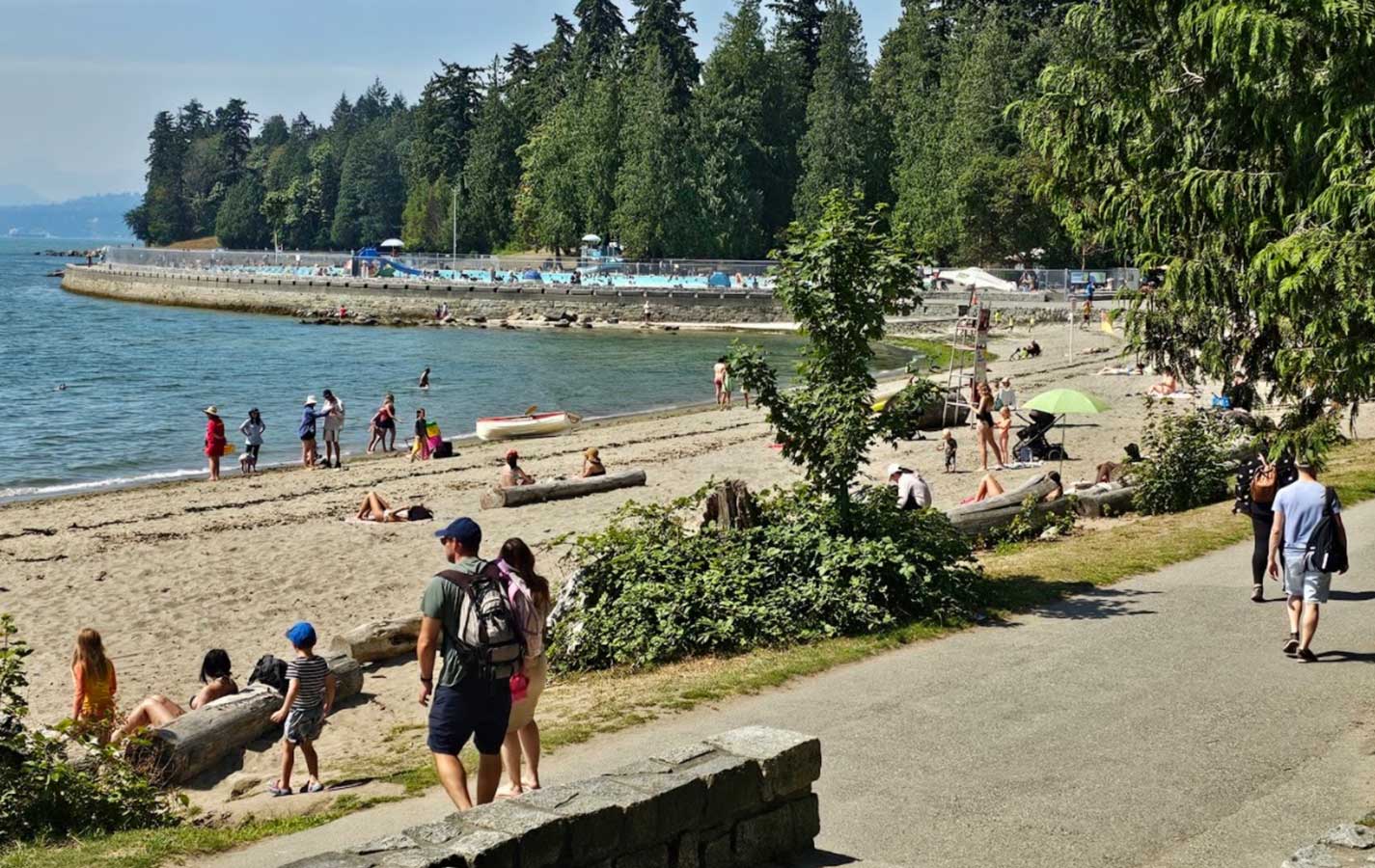
Vancouver has more than a dozen sandy beaches inside city limits, all free, most with lifeguards from late May to Labour Day.
| Beach | Vibe |
|---|---|
| English Bay | The classic: sunsets, the A-maze-ing Laughter statues, Celebration of Light fireworks |
| Sunset Beach | Quieter neighbour of English Bay; Inukshuk and Pride festival site |
| Second Beach | Stanley Park beach with a heated outdoor pool |
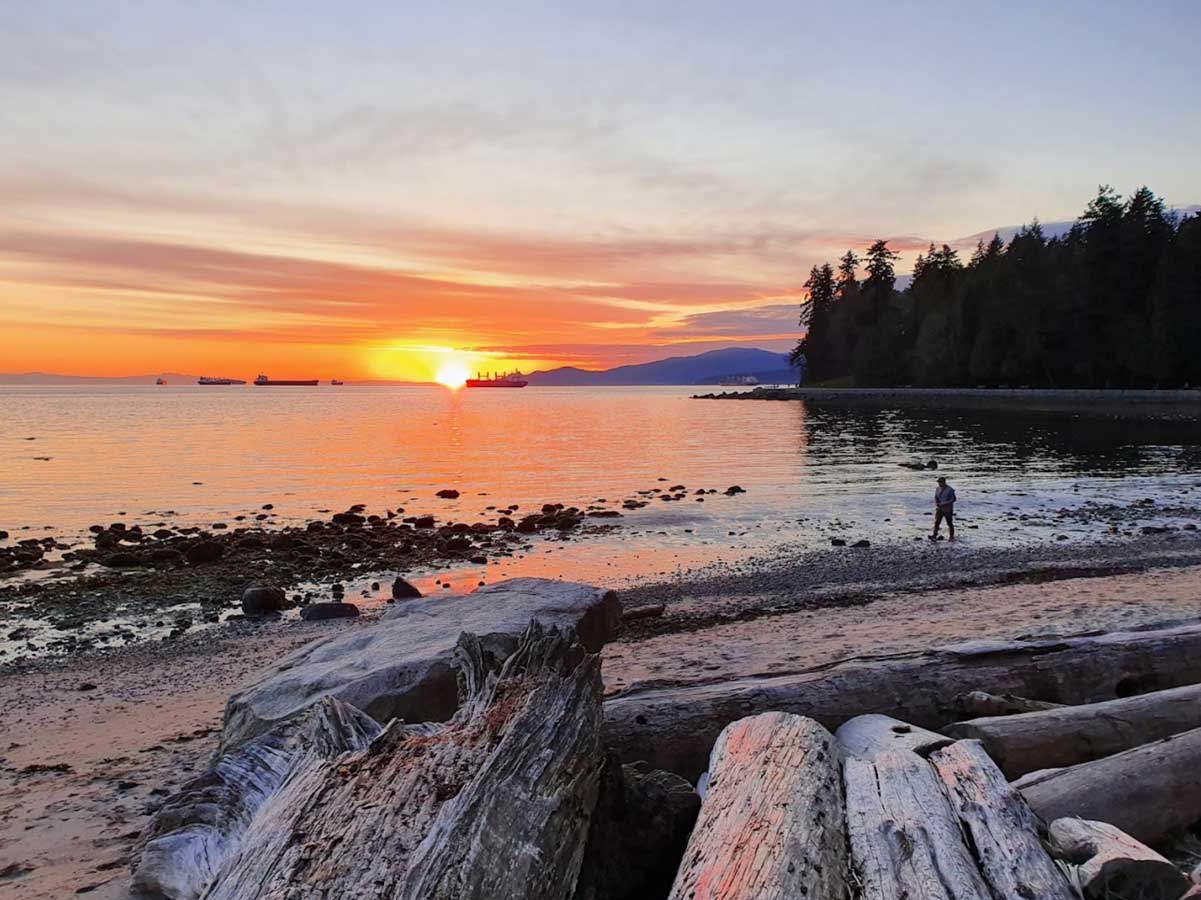
| Third Beach | Sheltered Stanley Park sunset spot, popular for evening drum circles |
| Kitsilano Beach | Volleyball, outdoor gym and Kits Pool, Canada's longest saltwater pool (137 m) |
| Jericho Beach | Sailing club, Folk Music Festival, calm water |
| Locarno Beach | Quiet, family-friendly, no music by design |
| Spanish Banks | Huge low-tide sand flats, kite-boarding, the best skimboarding in town |
| Wreck Beach | Clothing-optional beach below UBC; reached by about 470 steps |
| Trout Lake | Freshwater beach in East Van |
Check Vancouver Coastal Health's weekly beach water quality reports before swimming, especially after heavy rain.
Nature Near Vancouver: Rainforest, Mountains and Ocean
The region's "jungle" is temperate rainforest: towering western red cedars, Douglas firs and Sitka spruces draped in moss. You can walk through it in Stanley Park and Pacific Spirit Park without leaving the city. Within 30 to 45 minutes you reach:
- Capilano Suspension Bridge Park and the free Lynn Canyon Park suspension bridge (North Vancouver)
- Grouse Mountain, with the Skyride gondola, Grouse Grind hike, grizzly refuge and skiing
- Cypress Mountain and Mount Seymour for skiing, snowshoeing and summer hiking
- Deep Cove and Indian Arm for kayaking and the Quarry Rock hike
- Lighthouse Park and Whytecliff Park in West Vancouver for old-growth trees and tide pools
- The Sea-to-Sky Highway to Squamish (Sea to Sky Gondola, Stawamus Chief) and Whistler
- Whale watching tours from Granville Island and Steveston for orcas and humpbacks, April to October
Things to Do in Vancouver: Top Attractions
If you only have two or three days, start with Stanley Park, Granville Island, Gastown and Chinatown, and a sunset on English Bay or Kits Beach. Add a North Shore trip if the weather is clear.
Top 10 places to visit in Vancouver
- Stanley Park and the Seawall: rent a bike at Denman and Georgia and loop the park in about an hour.
- Granville Island: the Public Market, artist studios, Arts Club theatre and the little ferries across False Creek.
- Gastown: cobblestone streets, the Steam Clock, the Gassy Jack statue, boutiques and some of the city's best restaurants.
- Chinatown: one of the largest historic Chinatowns in North America, with the Millennium Gate, Sun Yat-Sen Garden and Chinese Canadian Museum.
- Canada Place and the Waterfront: sails, cruise ships, seaplanes, FlyOver Canada, and the Olympic Cauldron and Digital Orca at Jack Poole Plaza.
- Vancouver Aquarium: Canada's largest aquarium, in Stanley Park.
- Queen Elizabeth Park and Bloedel Conservatory: the city's best viewpoint and a tropical dome.
- Kitsilano: beach, pool, West 4th shopping and the Museum of Vancouver.
- Capilano Suspension Bridge or Lynn Canyon: rainforest canyon bridges across the inlet.
- Grouse Mountain: "the Peak of Vancouver," reachable by bus and gondola.
Full list of Vancouver attractions
| Attraction | Neighbourhood | Type |
|---|---|---|
| BC Place and BC Sports Hall of Fame | Downtown | Stadium, museum |
| Bill Reid Gallery | Downtown | Indigenous art |
| Bloedel Conservatory | Queen Elizabeth Park | Garden |
| Canada Place and FlyOver Canada | Waterfront | Landmark, flight ride |
| Chinatown and Millennium Gate | Chinatown | Historic district |
| Chinese Canadian Museum | Chinatown | Museum |
| Commercial Drive | Grandview-Woodland | Food and culture street |
| Davie Village | West End | LGBTQ2S+ district |
| Dr. Sun Yat-Sen Classical Chinese Garden | Chinatown | Garden |
| English Bay and A-maze-ing Laughter | West End | Beach, public art |
| False Creek and Seaside Greenway | False Creek | Waterfront path |
| Gastown Steam Clock | Gastown | Landmark |
| Granville Island Public Market | Granville Island | Market |
| H.R. MacMillan Space Centre | Kitsilano | Planetarium |
| Jack Poole Plaza and Olympic Cauldron | Coal Harbour | Landmark |
| Kitsilano Beach and Kits Pool | Kitsilano | Beach, pool |
| Main Street | Mount Pleasant | Shops, breweries, murals |
| Marine Building | Downtown | Architecture |
| Museum of Anthropology | UBC | Museum |
| Museum of Vancouver | Kitsilano | Museum |
| Nat Bailey Stadium | Riley Park | Baseball |
| Olympic Village | False Creek | Neighbourhood |
| PNE and Playland | Hastings-Sunrise | Fair, amusement park |
| Punjabi Market | Sunset | Shopping district |
| Queen Elizabeth Park | South Cambie | Park, viewpoint |
| Robson Street | Downtown | Shopping street |
| Rogers Arena | Downtown | Arena |
| Science World | False Creek | Science centre |
| Stanley Park | Stanley Park | Park |
| Vancouver Aquarium | Stanley Park | Aquarium |
| Vancouver Art Gallery | Downtown | Art museum |
| Vancouver Lookout | Downtown | Observation deck |
| Vancouver Maritime Museum | Kitsilano | Museum |
| Vancouver Public Library Central Branch and rooftop garden | Downtown | Architecture, garden |
| VanDusen Botanical Garden | Shaughnessy | Garden |
| Yaletown | Downtown | Dining district |
Easy day trips from Vancouver
- Richmond: Asian food capital of the region, summer Richmond Night Market, historic Steveston fishing village
- North Shore: Lonsdale Quay and the Shipyards by SeaBus, Grouse, Capilano, Lynn Canyon, Deep Cove
- Whistler: two hours up the Sea-to-Sky Highway; world-class skiing and mountain biking
- Victoria: BC's capital, by ferry or a 35-minute seaplane flight
- Bowen Island: 20-minute ferry from Horseshoe Bay
- Fort Langley: heritage village on the Fraser River
Sports Teams and Recreation in Vancouver
Vancouver is a hockey town first, but its real passion is being outside: running the seawall, cycling, kayaking False Creek, skiing the North Shore and hiking every weekend. The city has hosted the 1954 Commonwealth Games, the 2010 Winter Olympics and Paralympics, the 2015 FIFA Women's World Cup final, multiple Grey Cups and, in 2026, seven matches of the FIFA World Cup at BC Place.
Professional and major sports teams
| Team | League | Venue | Notes |
|---|---|---|---|
| Vancouver Canucks | NHL (hockey) | Rogers Arena | Since 1970; Stanley Cup finalists in 1982, 1994 and 2011 |
| BC Lions | CFL (Canadian football) | BC Place | Six Grey Cup titles |
| Vancouver Whitecaps FC | MLS (soccer) | BC Place | In MLS since 2011; club for sale since December 2024 and its future in Vancouver uncertain |
| Vancouver Goldeneyes | PWHL (women's hockey) | Pacific Coliseum | Expansion team that began play in 2025–26 |
| Vancouver Rise FC | Northern Super League (women's soccer) | Swangard Stadium (Burnaby) | Founding club of Canada's women's pro league, 2025 |
| Vancouver Canadians | Northwest League (High-A baseball) | Nat Bailey Stadium | Toronto Blue Jays affiliate; one of the prettiest ballparks in the minors |
| Vancouver Warriors | National Lacrosse League | Rogers Arena | Box lacrosse |
UBC Thunderbirds field strong university teams in Canada West and U Sports. Rugby, cricket, field hockey, ultimate and dragon boating all have big local followings.
Recreation facilities
The Park Board runs about two dozen community centres, nine indoor pools, outdoor pools at Kitsilano, Second Beach, New Brighton, Maple Grove and Mount Pleasant, eight ice rinks, three public 18-hole golf courses (Fraserview, Langara and McCleery), pitch-and-putt courses, tennis and pickleball courts, skate parks and dozens of off-leash dog areas. The Hillcrest Centre, built for 2010 Olympic curling, is a busy aquatic and fitness centre. A single "Flexipass" covers drop-in swimming, skating and fitness across the city, and the Leisure Access Program gives discounts to low-income residents.
Popular outdoor activities
- Running or cycling the Stanley Park Seawall and Seaside Greenway
- Kayaking, paddleboarding and sailing on False Creek and English Bay
- Skiing and snowboarding at Grouse, Cypress and Seymour, often after work
- Hiking the Grouse Grind, Quarry Rock, the Baden-Powell Trail and Lynn Headwaters
- Beach volleyball at Kits and Spanish Banks
- Kite-boarding and skimboarding at Spanish Banks
- Golf, with courses open most of the year
Annual Events and Festivals in Vancouver
Something big happens in Vancouver almost every week from May to September, and winter has its own calendar of food, film and lights. Dates shift each year, so confirm with organizers before planning a trip.
| Month | Event | Where |
|---|---|---|
| January 1 | Polar Bear Swim | English Bay |
| January–February | Dine Out Vancouver Festival | Restaurants citywide |
| January–February | PuSh International Performing Arts Festival | Various venues |
| January or February | Lunar New Year Parade | Chinatown |
| February–March | Vancouver International Wine Festival | Vancouver Convention Centre |
| April | Vancouver Cherry Blossom Festival | Parks and streets citywide |
| April | Vaisakhi Parade | Ross Street Gurdwara, South Vancouver |
| April | Vancouver Sun Run | Downtown |
| April | Lapu-Lapu Day celebration | South Vancouver |
| May | BMO Vancouver Marathon | Citywide |
| May–October | Farmers markets (Trout Lake, Kitsilano, Riley Park) | Neighbourhood parks |
| June | Car Free Day | Commercial Drive, Main Street and others |
| June | Italian Day on The Drive | Commercial Drive |
| June | Greek Day on Broadway | Kitsilano |
| June | Concord Pacific Dragon Boat Festival | False Creek |
| June–July | TD Vancouver International Jazz Festival | Citywide |
| June–September | Bard on the Beach | Vanier Park |
| July 1 | Canada Day celebrations | Canada Place and Granville Island |
| July | Vancouver Folk Music Festival | Jericho Beach Park |
| July | Khatsahlano Street Party | West 4th Avenue, Kitsilano |
| July | Indian Summer Festival | Various venues |
| Late July–early August | Honda Celebration of Light fireworks | English Bay |
| August (BC Day weekend) | Vancouver Pride Festival and Parade | West End and Sunset Beach |
| August | Vancouver Queer Film Festival | Various cinemas |
| August | Lululemon SeaWheeze Half Marathon | Downtown and Stanley Park |
| Late August–Labour Day | PNE Fair | Hastings Park |
| September | Vancouver Fringe Festival | Granville Island |
| Late September–October | Vancouver International Film Festival (VIFF) | VIFF Centre and cinemas |
| October | Vancouver Writers Fest | Granville Island |
| October | Halloween events and Fright Nights at Playland | Hastings Park |
| October–November | Diwali Fest | Various venues |
| November 11 | Remembrance Day ceremony | Victory Square |
| November | Eastside Culture Crawl | East Vancouver studios |
| Mid-November–December 24 | Vancouver Christmas Market | Jack Poole Plaza |
| December | Bright Nights in Stanley Park and VanDusen Festival of Lights | Stanley Park, VanDusen |
| December 31 | New Year's Eve celebrations | Canada Place and venues citywide |
Sustainability and Green City Goals
Vancouver has positioned itself as one of the greenest big cities in North America. Its electricity comes almost entirely from BC Hydro's hydroelectric dams, so the main climate challenge is heating buildings and moving people. The Greenest City Action Plan (2011–2020) was followed by the Climate Emergency Action Plan (2020), which aims to cut carbon pollution in half by 2030 from 2007 levels and reach net zero before 2050.
Key policies include a Zero Emissions Building Plan that requires new buildings to use low-carbon heating, the Neighbourhood Energy Utility that heats the Olympic Village and False Creek using waste heat recovered from sewage, a Zero Waste 2040 strategy, green rainwater infrastructure under the Rain City Strategy, and an urban forest plan to protect and expand tree canopy. Most trips into downtown are made by walking, cycling or transit. Rising seas are a long-term threat, so the city is planning flood protection for False Creek and the Fraser River shoreline.
City Services and Amenities
| Service | How to reach it |
|---|---|
| City services, bylaws, garbage, potholes | Dial 3-1-1 or use the VanConnect app |
| City Hall | 453 West 12th Avenue |
| Emergency (police, fire, ambulance) | 9-1-1 |
| VPD non-emergency | 604-717-3321 |
| HealthLink BC (nurse advice) | 8-1-1 |
| Garbage and green bin | Weekly green bin and biweekly garbage for houses; check the city's collection schedule |
| Parking | Pay by PayByPhone app or meter; residential permit parking in many areas |
Major hospitals in the city include Vancouver General Hospital, St. Paul's Hospital (moving to a new campus on the False Creek Flats), BC Children's and BC Women's Hospital, BC Cancer, Mount Saint Joseph Hospital and UBC Hospital, all run by Vancouver Coastal Health or Providence Health Care.
Vancouver FAQ
Is Vancouver the capital of British Columbia?
No. The capital is Victoria, on Vancouver Island. Vancouver is the largest city.
Is Vancouver on Vancouver Island?
No. The city is on the mainland. Vancouver Island is across the Strait of Georgia, about 90 minutes by ferry.
What is the best time to visit Vancouver?
June to September for dry, sunny weather and festivals. December to March for skiing and lower hotel prices.
Do I need a car in Vancouver?
Not usually. SkyTrain, buses and the SeaBus cover most attractions, and the Canada Line connects downtown to the airport in about 25 minutes.
Is Vancouver safe for tourists?
Generally yes. Use normal city precautions, never leave anything visible in a parked car, and be aware that parts of the Downtown Eastside around East Hastings Street have visible street disorder.
How many people live in Vancouver?
The 2021 census counted 662,248 in the City of Vancouver and about 2.64 million in Metro Vancouver.
What is the difference between Vancouver and Metro Vancouver?
The City of Vancouver is one municipality. Metro Vancouver is the regional district of 21 municipalities, including Burnaby, Surrey, Richmond, Coquitlam and the North Shore.
Sources
-
- City of Vancouver: Population
- City of Vancouver: Homeless Count
- City of Vancouver: 2025 Homeless Count preliminary results (memo to Council)
- City of Vancouver: Official 2025 by-election results
- City of Vancouver: Chief Constable Steve Rai
- Vancouver Public Library: Vancouver elections guide
- Province of British Columbia: Broadway Subway project update
- Statistics Canada: Census Profile, 2021 Census of Population
- City of Vancouver: 2021 Census – Immigration, Ethnocultural Diversity, Mobility and Migration