
City guide · Sea-to-Sky
Squamish city guide
Climbing, biking and kiteboarding town at the head of Howe Sound, under the granite walls of the Stawamus Chief.
01 At a glance
Welcome to Squamish
Squamish is an outdoor-recreation town about an hour north of Vancouver on the Sea to Sky Highway, between Howe Sound and the Coast Mountains. It suits climbers, mountain bikers, hikers and young families, and makes a more affordable base than Whistler.
- Vibe
- Outdoorsy, young, adventurous
- Best for
- Climbing, hiking, biking and eagle watching
- Getting around
- Highway 99 & coach from Vancouver
Squamish at a glance
Squamish sits at the head of Howe Sound, where the Sea to Sky Highway leaves the ocean and turns inland towards Whistler. It is roughly an hour’s drive north of downtown Vancouver and about 58 km south of Whistler, and the setting is dramatic: the granite walls of the Stawamus Chief tower over the south end of town, Shannon Falls pours down the cliffs beside the highway, and the Squamish, Cheakamus and Mamquam rivers meet in a wide valley ringed by mountains.
Once a mill and railway town, Squamish has become one of the outdoor-recreation capitals of Canada. Rock climbers come for the Chief and the Smoke Bluffs, mountain bikers for an extensive trail network, kiteboarders for the reliable summer winds on the Squamish Spit, and hikers for everything from short waterfall walks to all-day alpine routes. In winter, hundreds of bald eagles gather along the rivers near Brackendale.
The town is young and growing fast. The population rose by about 22 per cent between 2016 and 2021, driven partly by people leaving Vancouver and Whistler for more space and lower costs. Neighbourhoods run from Downtown and Dentville at the south end, through Valleycliffe, the Garibaldi Highlands and Garibaldi Estates, to Brackendale and the Northyards in the north.
Squamish suits active people of all ages: climbers and riders, young families who want trails from the back door, and remote workers who can trade a long commute for mountain views. Visitors use it as a day trip from Vancouver or a quieter, more affordable base for the Sea to Sky corridor.
A short history
Squamish lies in the territory of the Squamish Nation, the Sḵwx̱wú7mesh Úxwumixw, whose people have lived around Howe Sound and the Squamish River valley for thousands of years, as both oral history and archaeology confirm. Village sites were spread along the rivers and the shores of the sound, and the area that is now downtown Squamish carries the traditional name Keh Kait. The Stawamus Chief itself is known in the Squamish language as Siy̓ám̓ Smánit and is a place of cultural significance. Squamish Nation reserves remain within the area today, governed by the Nation rather than the municipality.
The modern town grew up in the 1910s as the first southern terminus of the Pacific Great Eastern Railway, which later became part of CN. Logging and forestry were the backbone of the economy for most of the twentieth century. The Village of Squamish was incorporated in 1948, and on 15 December 1964 it amalgamated with Brackendale and Mamquam to create the District of Squamish. The Royal Hudson steam train brought day-trippers from North Vancouver every summer between 1974 and 1999, and its legacy lives on at the railway museum in the north end of town.
The local pulp mill, long the town’s largest employer, closed in 2006, and Squamish reinvented itself around recreation, tourism and new residents. The Sea to Sky Gondola opened in 2014 and quickly became one of the region’s most visited attractions. Quest University, Canada’s first private, non-profit secular university, operated here from 2007 until 2023; its campus is now home to Capilano University’s Squamish campus. A large electric-powered liquefied natural gas export facility, Woodfibre LNG, is under construction on Howe Sound.
Top things to do in Squamish
Mountains and viewpoints
- Stawamus Chief Provincial Park protects the granite massif that rises more than 700 m above Howe Sound. Steep hiking trails lead to its three summits, and its walls hold hundreds of climbing routes. The park also has a walk-in campground.
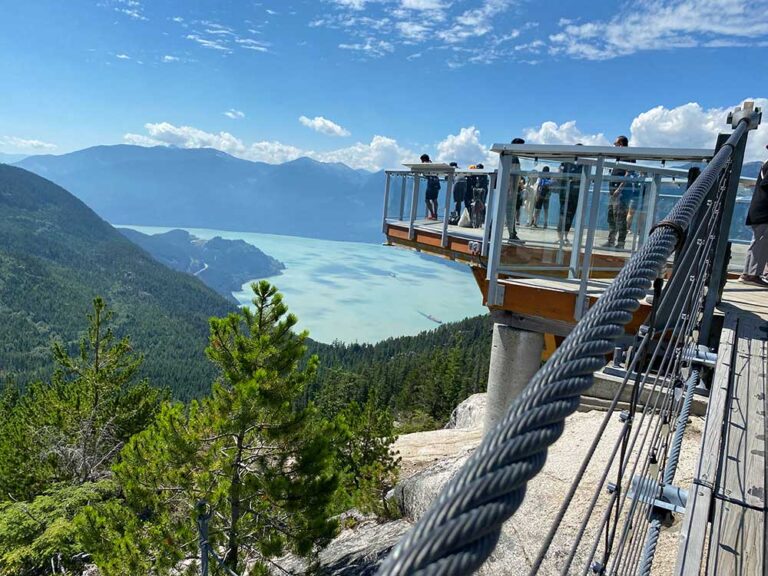
- Sea to Sky Gondola lifts you to a summit area at 885 m with viewing platforms, the 95-metre Sky Pilot Suspension Bridge, easy loop trails and longer hikes, plus a via ferrata for guided climbing.
- Shannon Falls Provincial Park, right beside Highway 99, has a short walk of less than a kilometre to the base of a 335-metre waterfall.
Rivers, lakes and wildlife
- Eagle viewing in Brackendale: bald eagles gather to feed on spawning salmon from late fall into winter. Watch from the Eagle Run dike and viewing shelter on Government Road; Brackendale Eagles Provincial Park itself is closed to visitors in winter to protect the birds.
- Alice Lake Provincial Park, a short drive north of town, has swimming beaches, a lake loop trail and one of the most popular campgrounds in the corridor.
- The Squamish Spit is one of the best kiteboarding and windsurfing spots in western Canada on warm, sunny summer afternoons, when the inflow winds are predictable.
Climbing and mountain biking
- Rock climbing: beyond the Chief, the Smoke Bluffs, Murrin Park, the Malamute and the Shannon Falls area together offer well over a thousand routes, plus thousands of boulder problems in the forest below the Chief.
- Mountain biking: the Squamish trail network spreads across the hillsides above the Garibaldi Highlands, Valleycliffe and the Alice Lake area, and suits intermediate and advanced riders. Local shops can point you to trail maps and current conditions.
Culture and history
- Railway Museum of British Columbia, formerly the West Coast Railway Heritage Park, displays historic locomotives and rolling stock and is a hit with children.
- Downtown Squamish, centred on Cleveland Avenue, has the town’s oldest commercial streets, local galleries and a short walk to the waterfront.
Food and drink
Squamish eats like an adventure town: hearty, casual and fuelled by coffee. Downtown, along Cleveland Avenue and the surrounding blocks, is the most walkable cluster of cafés, bakeries, pubs and restaurants, and the place to go for a sit-down dinner after a day outside.
Along Highway 99, the shopping areas around Garibaldi Village and the commercial strip at the north end of town are where you will find quick bites, larger family restaurants and grocery stores for stocking up before a camping trip. Brackendale has a small cluster of its own that is handy for the north-end trails and eagle viewing.
The local craft beer scene is popular, and patios fill up quickly on summer evenings when climbers and riders come off the hills. Summer events downtown add food stalls and outdoor seating, and the town’s growth has brought a steadily wider range of cuisines.
Where to stay
Downtown Squamish is the best base if you want to walk to restaurants and the waterfront, and it is close to the Chief, the Gondola and Shannon Falls at the south end of town.
The hotels and motels along Highway 99 suit road-trippers and anyone splitting time between Squamish and Whistler, with easy parking and quick highway access. Vacation rentals are spread through the Garibaldi Highlands, Valleycliffe and Brackendale, and are a good fit for groups and families.
Camping is a big part of the Squamish experience. Alice Lake Provincial Park and the walk-in campground at Stawamus Chief Provincial Park are the best-known options; both book up quickly in summer through BC Parks. Because Squamish is cheaper than Whistler, many visitors stay here and drive north for a day on the mountains.
Getting around
Driving from Vancouver: Squamish is about 65 km from downtown Vancouver on Highway 99, the Sea to Sky Highway, via the Lions Gate Bridge and West Vancouver. Expect roughly 50 minutes to 1 hour 15 minutes, longer on summer and holiday weekends when traffic backs up through West Vancouver and at the Squamish turnoffs. The highway is a mountain road; in winter, vehicles need proper winter tires, and you should check DriveBC for closures and conditions before you leave. Whistler is about 45 minutes to an hour further north.
Coach from Vancouver and YVR: There is no SkyTrain, TransLink or BC Transit service between Vancouver and Squamish. Instead, private coach companies run scheduled services. YVR Skylynx operates buses from Vancouver International Airport and downtown Vancouver (pickup on Melville Street) that stop in Squamish on their way to Whistler. Check schedules in advance, as departures vary by season.
Local transit: The Squamish Transit System is run by BC Transit with the District of Squamish. Its main routes include Route 1 (Brackendale), Route 2 (Highlands) and Route 3 (Valleycliffe), with extra weekday and Sunday trips added on the Brackendale and Highlands routes from January 2026. Fares can be paid with cash, the Umo app or card, or contactless payment. Service is modest by city standards, so check timetables.
Cycling and walking: Squamish is compact and largely flat on the valley floor, and paved multi-use paths make it easy to get between neighbourhoods by bike. For trailheads further afield, such as Alice Lake, a car or bike is the practical choice.
Seasons and events
Squamish has an oceanic climate with warm, mostly dry summers and cool, very wet winters. It is one of the rainiest inhabited places in Canada, with well over 2,000 mm of precipitation a year, most of it falling between October and March. Summer is peak season for climbing, biking, kiteboarding and camping. Late fall and winter bring the eagles, moody low cloud and quieter trails, and snow in town is usually light and short-lived.
- Eagle season (November to February): Bald eagle numbers usually peak between November and January along the Squamish and Cheakamus rivers. Mornings and mid-afternoons are the best viewing times.
- Squamish Days Loggers Sports Festival (BC Day long weekend): A long-running celebration of the town’s logging heritage at the Al McIntosh Loggers Sports Grounds, with axe throwing, chopping, sawing and tree-climbing competitions. The 2026 festival ran from 30 July to 2 August.
- Squamish 50 (mid-August): A well-known trail running weekend with 23 km, 50 km and 50-mile races on the local trail network. The 2026 edition ran on 15 and 16 August.
Living in Squamish
Squamish has been one of the fastest-growing communities in British Columbia, and its housing has changed quickly as a result. Older detached homes in Valleycliffe, Dentville and Brackendale sit alongside newer townhouse and condominium developments downtown, in the Northyards and along the highway corridor. Prices are lower than in Vancouver or Whistler but have climbed sharply, and rental housing is tight.
The town has a range of public elementary and secondary schools in the Sea to Sky School District, and post-secondary options through Capilano University’s Squamish campus, which offers diploma programs and university transfer courses on the former Quest University site. Squamish General Hospital provides local care, with larger hospitals on the North Shore and in Vancouver.
Squamish suits people whose priority is time outdoors. Many residents work locally in tourism, construction, trades, health and education, while others commute south to the North Shore and Vancouver or north to Whistler. The Sea to Sky Highway can be slow on weekends, and winter driving requires preparation, so remote or hybrid work is common.
Practical notes: budget for rain gear and good tires, expect busy trailheads on sunny weekends, and book summer campsites early. In return you get one of the most striking settings of any town in Canada, a strong community spirit and adventure close to the front door.
03 Don’t miss
Top things to do in Squamish
- 01
Stawamus Chief
Hike to three granite summits more than 700 m above Howe Sound.
- 02
Sea to Sky Gondola
Ride to 885 m for viewing platforms, the Sky Pilot Suspension Bridge and alpine trails.
- 03
Shannon Falls
A short walk to the base of a 335-metre waterfall beside the highway.
- 04
Brackendale eagles
Watch wintering bald eagles from the Eagle Run dike between November and February.
- 05
Alice Lake Provincial Park
Swimming beaches, lake trails and a popular campground north of town.
- 06
Squamish Spit
One of western Canada's top kiteboarding and windsurfing spots in summer.
- 07
Railway Museum of British Columbia
Historic locomotives and rolling stock in the north end of town.
- 08
Smoke Bluffs
Accessible granite crags close to downtown, popular with climbers of all levels.
On the map
Around Squamish
Squamish is about 50 to 75 minutes from downtown Vancouver on Highway 99. YVR Skylynx coaches stop in Squamish on the way to Whistler, and the BC Transit-run Squamish Transit System serves Brackendale, the Highlands and Valleycliffe. A car or bike is best for trailheads.
 Sea to Sky Gondola in SquamishAttractionsView →
Refresh & refuel
Where to eat & drink in Squamish
Get out there
Attractions in Squamish
Own a business in Squamish?
Get discovered by locals and visitors planning their time in the city.
FAQ
Squamish: good to know
How do I get to Squamish from downtown Vancouver?
Drive about 65 km north on Highway 99 via the Lions Gate Bridge, usually 50 minutes to 1 hour 15 minutes. YVR Skylynx coaches from downtown Vancouver and the airport also stop in Squamish.
Is there public transit from Vancouver to Squamish?
No TransLink or BC Transit route connects the two; travellers use private coaches such as YVR Skylynx or drive. Within Squamish, BC Transit runs local bus routes.
How far is Squamish from Whistler?
About 58 km, or roughly 45 minutes to an hour by car on Highway 99.
When is the best time to visit Squamish?
July to September is best for climbing, biking, camping and kiteboarding, while November to February is the time to see the bald eagles near Brackendale.
Is Squamish good for families?
Yes. Easy outings include Shannon Falls, the Sea to Sky Gondola, Alice Lake's beaches and the railway museum, and many young families live here for the outdoor lifestyle.
Can I visit Brackendale Eagles Provincial Park?
The park is closed to visitors in winter to protect the birds; watch the eagles instead from the Eagle Run dike and viewing shelter on Government Road in Brackendale.
Sources for the facts on this page
- Statistics Canada, 2021 Census of Population: Squamish (DM), population and land area (via Wikipedia, List of municipalities in British Columbia and Squamish, British Columbia)
- Squamish Chief: Squamish election 2026, official results confirm Sean Easton as mayor
- CBC News (via Yahoo News Canada): Squamish mayor, councillors sworn in, 3 November 2026
- Poliwave: Squamish municipal election results, 17 October 2026 (unofficial vote counts)
- Squamish Chief: Mayor Armand Hurford won't run in the next election
- District of Squamish: District of Squamish amalgamation took place 50 years ago (15 December 1964)
- Wikipedia: Squamish, British Columbia (history, climbing, climate, Capilano University)
- Wikipedia: Stawamus Chief; Wikipedia: Sea to Sky Gondola
- Tourism Squamish (exploresquamish.com): eagle viewing, Shannon Falls Provincial Park, Squamish Days Loggers Sports Festival 2026
- BC Parks: Brackendale Eagles Provincial Park
- Race Roster: Nesters Market Squamish 50, 2026
- Squamish Reporter: Squamish transit adds more trips on key routes (January 2026)
- YVR Skylynx: Downtown Vancouver to Whistler service with Squamish stop
- Squamish Reporter: WCRA is now the Railway Museum of British Columbia (2021)
Keep exploring
Nearby city guides
- North Shore & Howe Sound · 27.7 kmLions BayA small village on the Sea-to-Sky Highway with sheltered beaches below and some of…
- North Shore & Howe Sound · 38.2 kmBowen IslandA short ferry ride from Horseshoe Bay: forest trails, a harbour village and island…
- North Shore & Howe Sound · 41.5 kmWest VancouverSeawall villages, old-growth parks and Cypress Mountain on a quiet stretch of coast from…
- North Shore & Howe Sound · 41.7 kmNorth Vancouver (District)Canyons, rainforest and ski hills: Lynn Valley, Deep Cove, Edgemont and the mountains of…
- North Shore & Howe Sound · 43.8 kmNorth Vancouver (City)The walkable Lonsdale side of the North Shore: waterfront market, Shipyards and galleries, a…
- Tri-Cities & Northeast · 46.1 kmBelcarraA tiny seaside village where Burrard Inlet meets Indian Arm, home to beaches, picnics…